Showing posts with label = Total Collected. Show all posts

Cyprus - Croatia - Spain - Greece - Italy - Morocco - Portugal - Mediterranean Diet

"The Mediterranean diet involves a set of skills, knowledge, rituals, symbols and traditions concerning crops, harvesting, fishing, animal husbandry, conservation, processing, cooking, and particularly the sharing and consumption of food. Eating together is the foundation of the cultural identity and continuity of communities throughout the Mediterranean basin. It is a moment of social exchange and communication, an affirmation and renewal of family, group or community identity. The Mediterranean diet emphasizes values of hospitality, neighbourliness, intercultural dialogue and creativity, and a way of life guided by respect for diversity. It plays a vital role in cultural spaces, festivals and celebrations, bringing together people of all ages, conditions and social classes. It includes the craftsmanship and production of traditional receptacles for the transport, preservation and consumption of food, including ceramic plates and glasses. Women play an important role in transmitting knowledge of the Mediterranean diet: they safeguard its techniques, respect seasonal rhythms and festive events, and transmit the values of the element to new generations. Markets also play a key role as spaces for cultivating and transmitting the Mediterranean diet during the daily practice of exchange, agreement and mutual respect."

Source: UNESCO Intangible Cultural Heritage


Postcard 1 - Portugal
Multi-view of Mediterranean cuisine of Algarve, Portugal. Thanks to Tiago of Portugal. Received in November 2019.


Postcard 2 - North Cyprus - Cyprus 
Women cracking almonds. Collective food preparation in Mediterranean diet. Nice postcard of North Cyprus. It is an intangible cultural heritage inscribed under Cyprus. North Cyprus is not recognized as a national entity by UNESCO. Thanks to Marcel of Germany.

Brunei - Indonesia - Malaysia - Singapore - Thailand - Kebaya: knowledge, skills, traditions and practices

"Kebaya is a front-opening top often adorned with intricate embroidery and worn with fasteners such as brooches or buttons. It comes in various lengths and can be worn with a matching sarong. Kebaya is a way of dressing that has evolved with the lifestyles of Southeast Asian women. It is worn at casual as well as formal events, social gatherings and festivals. It is also worn in the performing arts, such as in dance performances, theatre and film. Contemporary designs are featured in beauty pageants and award ceremonies to reflect the wearer’s cultural identity. Making kebaya involves specific skills and knowledge related to the preparation, design, selection and cutting of fabrics and accessories, as well as different sewing and embroidery styles. Traditionally, these skills and knowledge have been transmitted informally from mothers to daughters. Over time, men have also become involved and formal training has become available through schools and workshops. Kebaya is a significant part of the cultural heritage and identity of various communities in Southeast Asia. Despite variations in how kebaya is made and worn, it is a common cultural element that transcends ethnicity, religion and borders, facilitating dialogue and uniting communities."

Source: UNESCO Intangible Cultural Heritage


Malaysia - Breakfast culture in Malaysia: dining experience in a multi-ethnic society

"Breakfast culture in Malaysia plays an important role among Malaysia’s multi-ethnic societies. The element can be found throughout the submitting State, which comprises 14 states. It is centred on food and spending time together over a morning meal. The element is a living heritage related to the traditional dietary practices which encompasses staple traditional foods such as Nasi Lemak, Roti Canai and drinks Teh Tarik. The element is practiced in both private and public spaces from the rural to urban areas. The Malays, Chinese, Indians, and other ethnic groups throughout Malaysia are both food producers and diners, and actively involved in the practice of the element. The preparation and consumption of Malaysian breakfast foods, although originally practiced by a particular ethnic group, has eventually become common and savoured by all, regardless of ethnic background. The foods are economical to produce and appreciated by people from all walks of life and ethnic backgrounds as an affordable and complete meal to start the day. The culture has been passed down from generation to generation to ensure the sustainability of local traditional culinary practices. Locals from different ethnic groups and genders unite around traditional breakfast delicacies. In addition to being a source of pride and a significant part of Malaysia’s gastronomic history, these morning dishes have also become a distinctive element of culture and identity that connects diverse ethnic groups within Malaysia."

Source: UNESCO Intangible Cultural Heritage


Thailand - Songkran in Thailand, traditional Thai New Year festival

In Thailand, Songkran refers to the sun’s annual passing into the Aries constellation, the first sign of the Zodiac, which marks the traditional start of the new year. Occurring in mid-April after the rice harvest, it is a time when people reunite with their families and pay their respects to older adults, ancestors and sacred Buddha images. Pouring water is a significant act during Songkran, symbolizing cleansing, reverence and good fortune. Other activities include bathing important Buddha images, splashing water on family and friends, folk plays, games, music and feasting. The tradition is passed on through participation in the festivities. Parents transmit the tradition to their children orally through regular social and family interactions. Educational institutes, government agencies, the media and Thai astrologers also play an important role in preserving, promoting and transmitting the astrological knowledge and wisdom related to Songkran. Songkran promotes community cooperation, unity and forgiveness. It is viewed as a time to symbolically wash away misfortunes, pray for prosperity for the coming year, reunite with family members, and honour ancestors and older adults. Furthermore, by emphasizing the importance of older adults and of family, Songkran helps to combat loneliness and social isolation.

Source: UNESCO Intangible Cultural Heritage

Thailand - Tomyum Kung

"Tomyum Kung is a traditional prawn soup from Thailand. The prawns are boiled with herbs, including lemongrass, kaffir lime leaves, galangal root and shallots, then seasoned with local condiments. It has a recognizable aroma and vibrant colours, and combines many tastes, including sweet, sour, savoury, spicy, creamy and slightly bitter. The dish originated among the Buddhist riverside communities in the Central Plains of Thailand, a plentiful region that for centuries has been the main production area of the nation’s food. These communities traditionally avoided killing large animals, preferring to eat the naturally abundant freshwater prawns. This preference, combined with their local knowledge about medicinal herbs, led to the development of the dish, which is believed to promote energy and wellness, particularly during the monsoon season. The related knowledge and skills – including the cooking, the selection of herbs and other ingredients, and the conservation of the environment – are transmitted orally, within families and at social and cultural gatherings. As the dish’s popularity has grown nationally and internationally, it is now also transmitted through restaurants, organizations, schools and universities. Tomyum Kung is a reflection of Thai Buddhist values and the embodiment of traditional knowledge of the local environment and resources."

Source: UNESCO Intangible Cultural Heritage


Germany – Saudi Arabia – Austria – Belgium – United Arab Emirates – Spain – France – Hungary – Italy – Kazakhstan – Morocco – Mongolia – Pakistan – Portugal – Qatar – Syrian Arab Republic – Republic of Korea – Czechia - Falconry, A Living Human Heritage

"Originally a method of obtaining food, the practice of falconry has evolved over time to be more associated with nature conservation, cultural heritage and social engagement within and amongst communities. Following their own set of traditions and ethical principles, falconers train, fly and breed birds of prey (which includes besides falcons, birds such as eagles and hawks) developing a bond with them and becoming their main source of protection. The practice, present in many countries around the world, may vary regarding certain aspects, for example the type of equipment used but the methods remain similar. Falconers regard themselves as a group and may travel weeks at a time engaging in the practice, while in the evenings recounting stories of the day together. They consider falconry as providing a connection to the past, particularly for communities for which the practice is one of their few remaining links with their natural environment and traditional culture. Knowledge and skills are transmitted in an intergenerational manner within families by formal mentoring, apprenticeship or training in clubs and schools. In some countries, a national examination must be passed in order to become a falconer. Field meets and festivals provide opportunities for communities to share knowledge, raise awareness and promote diversity."

Source: UNESCO Intangible Cultural Heritage

Collected: Austria, France, Mongolia, Qatar, UAE, Germany (6 countries)

Missing: Austria, Belgium, Czechia, Hungary, Italy, Kazakhstan, Morocco, Pakistan, Portugal, Saudi Arabia, South Korea, Spain, Syria (missing 13 countries)

Postcard 1 - Falconry in France 
Spectacle de Fauconnerie Equestre was held in Provins. Thanks to Sylvie of France who went to see this performance and bought this postcard.


Postcard 2 - Falconry in Mongolia
A postcard of Mongolian falconry. Falconry is now listed in 2010 as UNESCO Intangible Cultural Heritage in Mongolia, France, UAE and other countries. This is my 3rd postcard sent from Mongolia. Thanks to Cliffe.


Postcard 3 - Falconry in Qatar
Falconry in Qatar. Thanks to Ashraf of Qatar.


Postcard 4A - Falconry of United Arab Emirates
Falcons are important in UAE. Falcon is seen in the UAE stamps used. Thanks to Cazz of UK for sending this card from Ras Al Khaimal, one of the seven emirates of UAE.


Postcard 4B - Falconry in UAE
Awesome postcard of falconry of UAE. Thanks to Jean-Pierre France for mailing from Sharjah, UAE.


Postcard 4C - Falconry in UAE 
Nice falcon postcard with matching falcon stamps. Thanks to Jean-Pierre of France.


Postcard 4D - Falconry in UAE 
Falcon Center, Dubai, United Arab Emirates with special Dubai Expo 2020 cancelation. Thanks to Jean-Pierre of France. Postmarked March 23, 2022 and arrived on April 1, 2022.


Postcard 4E - Falconry in UAE 
A nice Falconry postcard of Dubai, UAE. Thanks to Jean-Pierre of France.


Postcard 5 - Falconry in Germany 
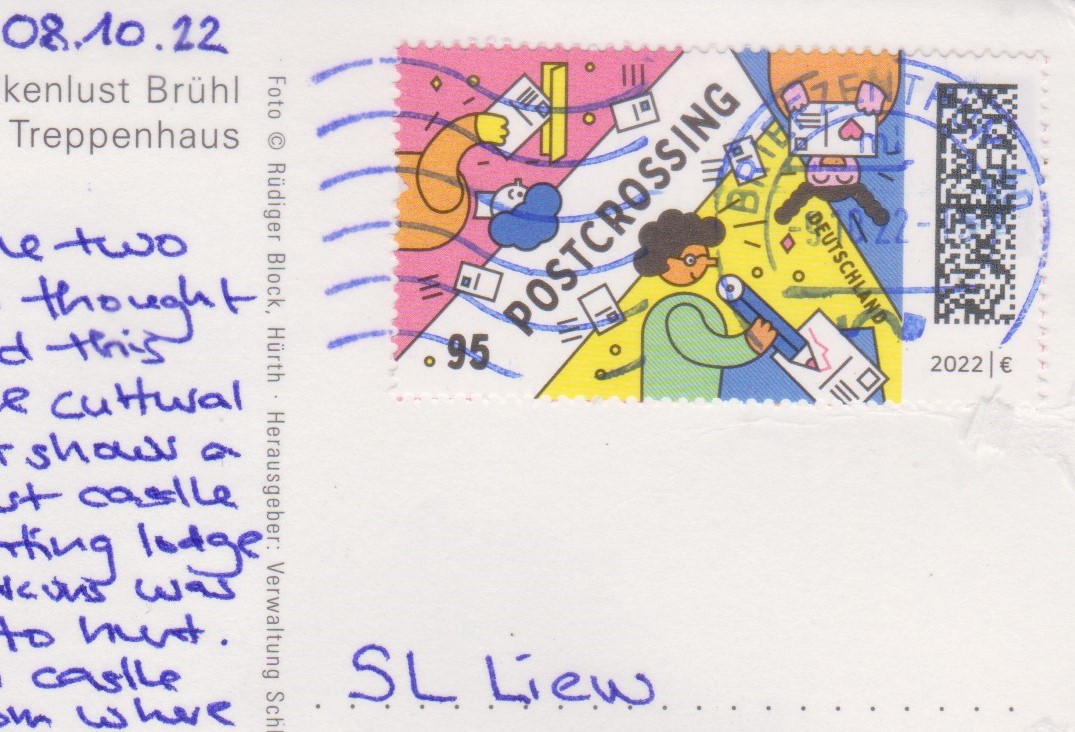
The falconry motif of a staircase tile of Falkenlust Hunting Lodge, Bruhl, Germany. Falconru is a UNESCO Intangible Cultural Heritage in Germany. Thanks to Marcel of Germany.

China - Art of Chinese Seal Engraving

"The art of seal engraving is a cornerstone of Chinese fine arts. The seal was originally used as a signature or sign of authority, but it came to be used by all social classes and in much of Asia. The Seal Engravers’ Society of Xiling in Zhejiang Province, central China, which was founded a century ago, preserves the art of seal engraving along with approximately a hundred other specialized institutions. The design is first sketched on paper, and then engraved on stone, in reverse, with a knife. In addition to mastery of traditional calligraphy, the art of engraving requires a high degree of virtuosity, since the artist works on a tiny surface area where every curve, every thickness of line counts. The very diverse motifs are the fruit of the artist’s imagination and culture. As an instrument of calligraphy and painting, the seal is a work of art in itself. It expresses an entire culture’s ideas about humankind and nature. Today, seals continue to be used in official documents and private correspondence. Even though those understanding the complex characters are ever fewer, the art of seal engraving is still practised by both professionals and amateurs." Source: UNESCO Intangible Cultural Heritage

Postcard 1
Different seals shown at 1998 Shanghai International Festival of Arts. Thanks to Shi of China.


Postcard 2
A cool maxicard of China Seal Engraving - a UNESCO Intangible Cultural Heritage. Thanks to Fu Ping of Beijing, China.

China - The Twenty-Four Solar Terms

The Twenty-Four Solar Terms, knowledge in China of time and practices developed through observation of the sun’s annual motion:

"The ancient Chinese divided the sun’s annual circular motion into 24 segments. Each segment was called a specific ‘Solar Term’. The element of Twenty-Four Solar Terms originated in the Yellow River reaches of China. The criteria for its formulation were developed through the observation of changes of seasons, astronomy and other natural phenomena in this region and has been progressively applied nationwide. It starts from the Beginning of Spring and ends with the Greater Cold, moving in cycles. The element has been transmitted from generation to generation and used traditionally as a timeframe to direct production and daily routines. It remains of particular importance to farmers for guiding their practices. Having been integrated into the Gregorian calendar, it is used widely by communities and shared by many ethnic groups in China. Some rituals and festivities in China are closely associated with the Solar Terms for example, the First Frost Festival of the Zhuang People and the Ritual for the Beginning of Spring in Jiuhua. The terms may also be referenced in nursery rhymes, ballads and proverbs. These various functions of the element have enhanced its viability as a form of intangible cultural heritage and sustain its contribution to the community’s cultural identity. Knowledge of the element is transmitted through formal and informal means of education."

Source: UNESCO Intangible Cultural Heritage.

Postcard 1 - Little Snow 小雪
Nice postcard of 小雪 Little Snow one of the 24 solar terms.  Thanks to Wulifei of China.


Postcard 2 - Autumn center (Equinox) 秋分 
Autumn center (Equinox) 秋分 is one of the 24 solar terms is mailed from Taiwan. Thanks to Maicy of Taiwan.


Postcard 3 - Summer Solstice 夏至
Summer Solstice 夏至"Xia Zhi" is the tenth of the 24 lunar terms in China and part of UNESCO Intangible Cultural Heritage. It marks the longest day and shortest night of the year - lotus bloom in Forbidden City, Beijing. Thanks to Edwin of China. Mailed on April 10, 2020 and arrived in Penang on June 10, 2020.


Postcard 4A - Dong Zhi 冬至
Dong Zhi 冬至 Winter poem postcard. Thanks to Yumi of Guangzhou, China.


Postcard 4B - Dong Zhi 冬至


Postcard 4C - Dong Zhi 冬至


Postcard 5 - Frost Descent 霜降 
A unique postcard of one of the Chinese 24 Solar Terms - Frost Descent 霜降 Mailed on October 23, 2022 which is Frost Descent Day. This Chinese 24 Solar Terms is a UNESCO Intangible Cultural Heritage. Thanks to Fu Ping of Beijing, China.